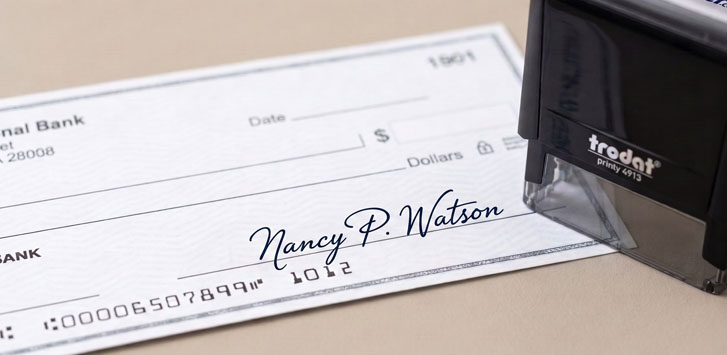
Signing one document takes only a moment. Signing dozens of checks, forms, letters, or cards can become tiring and time-consuming, especially for someone with limited hand mobility. A signature stamp offers a convenient way to reproduce your handwritten signature without writing it out each time.
However, a signature stamp should be used with care. It can represent your approval, and not every organization or document accepts one. Knowing when to confirm the rules can help you use yours confidently and securely.
What is a signature stamp?
A signature stamp is a custom rubber stamp made from an image of a person’s handwritten signature. When pressed onto paper, it creates a consistent ink impression that closely resembles the original signature.
Unlike a stamp that displays a typed name, it reproduces the curves, spacing, and other details of the submitted signature. This allows the user to reproduce their handwritten signature without signing each item individually.
Signature stamps are available in several styles:
- Self-inking signature stamps have an internal pad that re-inks the stamp between impressions, making them convenient for regular office use.
- Pre-inked signature stamps hold ink within the stamp and produce sharp impressions without a separate pad. They are practical for high-volume use.
- Wood-handle signature stamps require a separate ink pad. They are economical and let you switch among compatible ink colors.
The best option depends on signing volume, portability, and whether you want the flexibility of a separate ink pad.
Who can benefit from a signature stamp?
Anyone who regularly signs routine materials may find a signature stamp useful. It can save time, create a consistent impression, and reduce the physical effort involved in signing multiple items. People who may benefit include:
- Business owners and office professionals: Use a signature stamp for approved paperwork, internal forms, outgoing correspondence, and checks when accepted by their bank.
- Authors: Sign books, promotional materials, or correspondence more efficiently.
- Teachers and school administrators: Add signatures to certificates, cards, letters, and other approved documents.
- Community leaders: Sign routine correspondence, certificates, and event materials.
- People with disabilities or limited mobility: Sign more independently and with less strain when arthritis, tremors, limited dexterity, muscle weakness, injuries, or other conditions make handwriting difficult, painful, or inconsistent.
For people who find handwriting difficult, a signature stamp can provide greater independence while reducing the discomfort or effort involved in signing.
How to make a signature stamp
Making a custom signature stamp starts with preparing a clean copy of your handwritten signature. The quality of that original image will affect how closely the finished stamp matches it. Use plain, unlined white paper and a black ballpoint pen that creates a crisp, solid line. Avoid pencils, markers, light ink, or paper with a printed line.
Sign naturally at the size you want the stamped impression to be, keeping in mind the signature fields where you will use it. Leave clear white space around the signature so it can be reproduced without picking up stray marks.
Next, scan the page or take a bright, straight-on photo. Make sure the image is focused, evenly lit, and free of shadows. Crop it without cutting off flourishes, dots, or letter endings, then confirm that every intentional line is visible.
How to get a signature stamp from The StampMaker
Once your signature image is ready, ordering a custom signature stamp with The StampMaker is simple:
- Choose a stamp style and size. Compare models based on your expected use and the space available on the documents you sign.
- Upload the signature. Select a signature-stamp product and follow its upload instructions, or submit the image through The StampMaker’s custom stamp designer.
- Review the design carefully. Confirm that the preview shows the complete signature and will fit your typical signature line.
- Customize your stamp. Choose the available ink color and any model-specific options before adding the stamp to your cart.
- Place the order. The StampMaker will use the submitted image to create the personalized stamp. Most custom stamps ship the next business day, although turnaround times vary for certain products.
If you can’t upload a digital copy of your signature, The StampMaker provides a printable form that you can mail with a hard copy. Review the signature stamp ordering instructions to avoid delays caused by faint ink, lined paper, or stray marks.
Can you use a signature stamp on legal documents?
In some cases, but signature stamps are not accepted on every legal document. Whether you can use one may depend on several factors:
- The signer’s intent: The stamp must be used to show that the signer approves the document.
- Proper authorization: Anyone applying the stamp on another person’s behalf must have clear permission to do so.
- Applicable laws: Requirements may vary by state, document type, or transaction.
- The receiving organization’s policy: Banks, government agencies, healthcare providers, and other organizations may set their own signature requirements.
For checks and other negotiable instruments, regulations state that a signature may be made manually or by a device or machine, provided that the name, word, mark, or symbol is used with the intention of authenticating the document.
Other documents may have stricter requirements. Wills, trusts, deeds, court documents, notarized records, government forms, medical records, and tax filings may require a handwritten signature, identity verification, or special authorization.
Before stamping a legal document, confirm that it is permitted. If the document involves money, property, or another important legal right, consult a qualified attorney. This article provides general information and is not legal advice.
How to get a clean signature stamp impression
A clean impression is easier to read and less likely to look incomplete or smudged. Before stamping an important document, practice on scrap paper, especially when the stamp is new or has recently been re-inked. A few simple techniques can also help you create a clear, consistent signature:
- Use a flat surface: Place the document on a smooth, stable surface so the entire stamp can make even contact with the paper.
- Position the stamp carefully: Align the stamp with the signature line before pressing down.
- Apply even pressure: Press firmly and evenly without rocking or sliding the stamp, which can blur the signature.
- Lift the stamp straight up: Removing it at an angle may smear the ink or distort the impression.
- Allow the ink to dry: Wait before stacking, folding, or mailing the document. Coated surfaces may require specialty ink and additional drying time.
- Re-ink carefully: If impressions become faint, follow the manufacturer’s directions for re-inking the stamp or replacing the pad. Use the recommended ink and add only the suggested amount, since excess ink can fill fine spaces and cause smudging.
Keep your signature stamp secure
A signature stamp is more sensitive than an ordinary office stamp. Store it in a locked drawer, cabinet, or other access-controlled location rather than on a shared desk to prevent misuse.
When using a signature stamp in the workplace, limit access to authorized people and create a written policy explaining when the stamp may be used. Require a review before each signature is applied, and keep a record of stamped checks, contracts, or approvals.
If the stamp is lost or stolen, contact your bank, employer, or any other organization that has authorized its use. Review recent account activity and any documents the stamp could have been used to approve. When you no longer need the stamp, dispose of it so the signature image is unusable.
Make repetitive signing simpler with the StampMaker
A custom signature stamp can make frequent signing faster and more manageable, whether you are handling office documents, letters and cards, or personal projects. It can help busy professionals and people who find handwriting difficult.
The key is to match the stamp to the task. Prepare a clean signature image, choose a style that suits your signing volume, confirm acceptance before using it on important documents, and protect it as carefully as other tools that represent your identity.
Explore The StampMaker’s signature stamp options to find the right size and format for your needs.